Membrane Filtration MF,UF,NF and RO
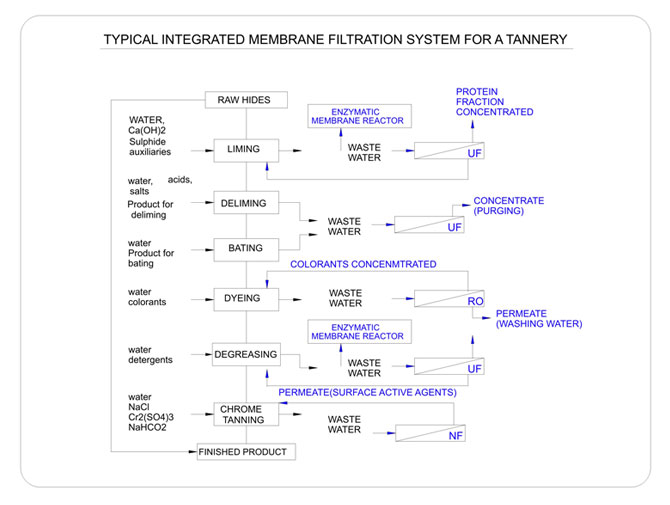
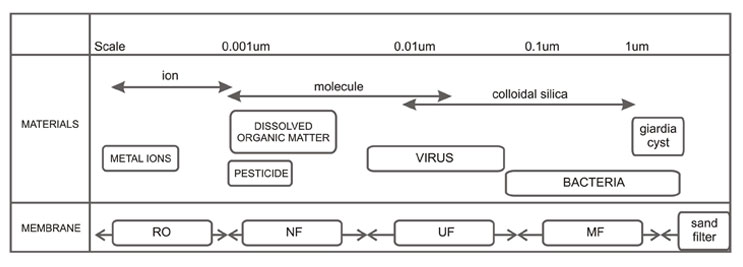
Membrane Filtration using MF (Micro Filtration - 0.1 to 1 µm) and UF (Ultra Filtration - 0.01 to 0.1µm) excels other conventional filtration methods on both quality of effluent, requirement of energy and space, ease of operation and maintenance. In the membrane filtration, liquid is pressurized while passing tangentially (cross flow) through a semi-permeable membrane, the liquid selectively pass through the membrane, leaving desired particle sized suspended solids behind. The liquid is separated into thick concentrate and clean liquid. The concentrate and the clean liquid are either reused or undergo further process.
The NF (Nano Filtration 0.001 to 0.01µm) and RO (Reverse Osmosis - 0.0001 to 0.001µm) similarly used for separation of dissolved salts and ions efficiently and economically than other process like evaporation. In RO, dissolved inorganic salts and silica are left behind the membrane, while clear water passes through. Sea water desalination and processing brackish water for drinking through RO proves its credential use.
3R Technology offers Modular units of MF, UF, NF and RO for reducing the volume of the wastewater and other process liquids for recovery of water or chemicals in the concentrate.
The integrated system for Zero Discharge or process unit operations are built with modular membrane units which are economical operation and gives the desired quality of end products.
The Membrane filtration units from 3R Technology are integrated in the systems for Zero Discharge or Recovery of valuable chemicals for recycle/reuse similar to the figure shown regarding Plating Chemical and water Recovery using RO and Evaporator.

Advantages and Features
Application MF and UF
NF and RO